
Young Washington Is Old History
Bi-George, from the Washington Portfolio ’74, by Michael Clark, 1974. [Smithsonian American Art Museum]
Beware of attending a historical film with a historian. In graduate school, my wife Taryn made this innocent mistake. She endured a screening of The Patriot on its opening weekend in Princeton, New Jersey, with me and my graduate school friends. After sitting through snickers, gasps, and bellowing laughter for nearly three hours, she swore that she would never go to a movie with a group of historians again.
I was reminded of this experience while viewing the new film Young Washington. The coming-of-age tale about George Washington, produced by the Christian faith-based Wonder Project and Angel Studios and financed, in part, by Charles Koch’s philanthropic organization Stand Together, plays loose with facts. As in real life, the young Washington seeks to navigate the British imperial bureaucracy as a rising provincial military officer in the 1750s. We see Washington dispatched to the Ohio country in 1753 by Virginia’s acting governor, Robert Dinwiddie (played like a stern schoolmaster by Ben Kingsley), to trace France’s growing presence in the region. The following year, Washington returns to the Ohio country with Tanaghrisson, a Seneca chief and British ally, and they start the French and Indian War, which became the Seven Years’ War, by attacking a French military party. The film culminates with Washington joining British Major-General Edward Braddock’s ill-fated 1755 attempt to eliminate the French threat in the Battle of the Monongahela. As Braddock and other British officers perish, Washington overcomes his inexperience and a nasty case of dysentery to lead Britain’s regular and provincial forces away from the catastrophic defeat. All the while, Washington feels the sting of being denied a royal commission to serve as a regular officer in the British army.
These events all took place. The film understandably compresses time and historical figures and even manages to translate the misery of dysentery to the screen, no easy feat. The problem here is not its narrative framing, but rather its national one. The film, released during America’s 250th anniversary, doesn’t portray young Washington as the arrogant, highly anglicized British subject that scholars have shown him to be. Instead, he is a moralistic proto-American ready to pursue independence by the closing credits. The only thing British about Washington is the actor William Franklyn-Miller who was cast to play him.
Everything that scholars know about young Washington — which is, admittedly, not very much — screams “Anglicization.” The historian John M. Murrin coined this term to describe the growing Britishness of the American colonists over the course of the 18th century. At age 14, Washington nearly followed his older half-brother Lawrence into the Royal Navy; George’s mother intervened to keep him on the tobacco planter track. In the other most documented event of young George’s life before the French and Indian War, he and Lawrence traveled to Barbados hoping that the hot, humid climate would bring the older sibling relief from tuberculosis. The journey did not cure Lawrence, who would die in July 1752, but it did allow George to marvel at polite British society and the island’s imperial military establishment, which he summarized in his trip diary as “one entire fortification.”
Washington’s pursuit of a royal commission underlined his British identity. Instead of petitioning for a commission just once, as the film depicts, Washington quested fruitlessly for a commission for four years. What the film and many Washington biographers fail to grasp is that he likely could have secured a commission as an ensign or lieutenant, possibly through purchase, as did a handful of other colonists during the war. (Washington even helped some.) He insisted, however, on retaining the same elevated rank of colonel that he held in the provincial army. Nothing so reflected Washington’s sense of entitlement and exaggerated British ambitions.
Young Washington’s protagonist offers to resign his command of the Virginia Regiment, the colony’s semiprofessional militia force, after the unit’s disastrous defeat at Fort Necessity in July 1754. Washington did resign his provincial commission after the defeat — but not out of shame. It was because he had learned that Dinwiddie planned to convert the Virginia Regiment into independent companies, with royal commissions for the officers, none of whom would rank higher than captain. Rather than give up his colonelcy, Washington decided to resign from the regiment, even if it meant not getting a royal commission. In the film’s telling, Washington’s British motivations disappear in place of actions, guided by providence, that destine him for his ur-American identity.
Other characters are protected from realities inconvenient to the Washington myth as well. Whereas the real young Washington enjoyed a flirtatious relationship with his best friend’s wife, Sally Fairfax, even while engaged to marry Martha Dandridge Custis, the film depicts Sally as being safely single. It also shows Lawrence — who so revered the British Empire that he renamed his plantation “Mount Vernon” in honor of the British admiral, Edward Vernon, under whom he served in war — leading young George to question the actions of that empire. In the movie, Lawrence advises George that “even a pawn can take a king.” Never mind that the brothers self-identified, at worst, as knights. Nor that the ailing Lawrence offers this improbable subversion while living several years longer than he did in real life. May all our film afterlives be so glorious.
The liberties taken by Young Washington are not new, but rather follow the paths of earlier films as well as Washington’s earliest biographer. Watching the onscreen relationships between George and people of color, I was again reminded of The Patriot, a film that outrageously downplays the horrors of slavery. After acknowledging that George inherited enslaved workers at age 11, following his father’s death, Young Washington distances its hero from the institution. In one scene, domestic workers enslaved by the powerful Fairfax family even help George to crash a party to which he almost certainly would have had an invitation.
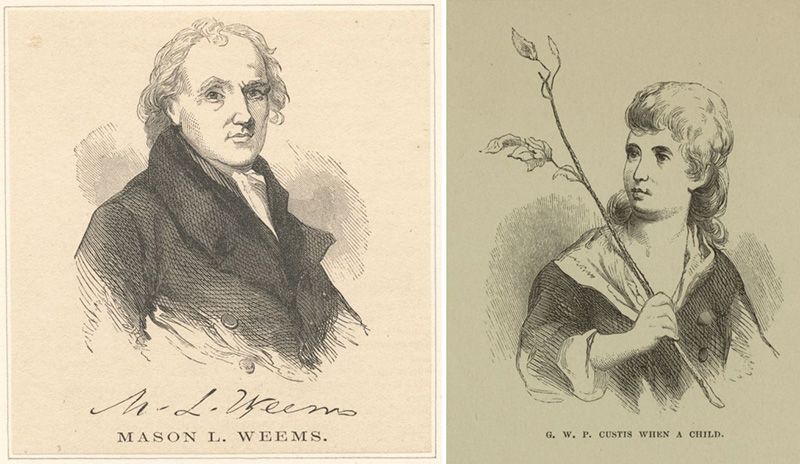
Native Americans stand in awe of the film version of Washington. The movie ends (spoiler alert) with Native warriors and a spiritual leader voicing the “Indian Prophecy,” a 19th century fable about Washington’s miraculous survival at the Battle of the Monongahela. It is never reassuring when a movie about early America takes its evidence from the 19th century, which shamelessly and sentimentally lied about the 18th century. The roots of the Indian Prophecy first appeared in the 1800 biography of Washington by Mason Locke “Parson” Weems. A generation later, another fabulist — Washington’s step-grandson George Washington Parke Custis — would publish further embellishments of the story in his 1827 play, The Indian Prophecy. The story goes that during a 1770 trip to what is now West Virginia, Washington and his doctor James Craik encountered an Indian sachem who had fought at the Battle of the Monongahela. The sachem prophesized that the improbable survivor of that battle would “become the chief of nations, and a people yet unborn, will hail him as the founder of a mighty empire.” No documented evidence supports this tale.
In truth, Washington had a complicated relationship with Indigenous people. Upon first meeting Tanaghrisson, the Seneca chief featured in Young Washington, the actual Washington boasted of his Indian name, first given to his great-grandfather John Washington: Conotocarious, which translates roughly to “Town Destroyer.” Far from being the object of awe, the inexperienced colonist wanted to impress Tanaghrisson. Senecas would later revive the name in condemnation of Washington’s genocidal campaign against them and other nations of the Haudenosaunee (Iroquois) Confederacy during the American Revolutionary War.
Weems’ biography, published just months after Washington’s death, turned the reserved, rational Enlightenment figure into a sentimental, evangelical Christian. Later editions of the biography would introduce numerous other fables, including the ones about the cherry tree and General Washington kneeling in prayer at Valley Forge, which remain central to his memory.
The film does not portray Washington as the devout figure from the Weems biography, but Young Washington still hints at a divine protection afforded its protagonist. After falling into the Allegheny River in December 1753 with his guide Christopher Gist, the companions make it to land (never mind that Washington’s own account suggests that he initially fell in alone and Gist saved him). They awake to find the river miraculously frozen, which would have been completely normal at the time. A closeup of Washington’s feet walking on the frozen Allegheny gives the unmistakable impression that the young American walks on (frozen) water. He is not quite Jesus, but close enough.
Before Young Washington, Hollywood had paid surprisingly little attention to the quintessential American. The one previous feature film to focus squarely on him, When the Redskins Rode (1951), also portrayed Washington’s young life. That film rewrites Washington’s crushing defeat at Fort Necessity in 1754 into a victory, delivered, no less, by Delaware Indians. In actuality, Delaware warriors joined the French and other Native allies in overwhelming Washington’s aptly named fort. The film, made in the heyday of the American western, transferred the genre’s familiar themes of White settlers triumphing over Indian savages, often through the help of innocent, noble Indians, to the colonial era. By this standard, Young Washington is Herodotus.
Why do Americans continue to stretch the truth, 19th-century style, about the country’s founders? Recent policy debates have reminded us that the myth-making efforts may have very real-world implications. In the leadup to the 250th anniversary commemorations that are reaching their zenith this week, both the vice president and president have attacked the notion of America as a creedal nation rooted in the ideals articulated in the Declaration of Independence. As Vance argued at the Republican National Convention in 2024, “America in not just an idea. It is a group of people with a shared history and a common future. It is, in short, a nation.”
The seemingly benign words set off alarms in the American historical community, even inspiring one of Gordon Wood’s last essays. Vance channeled a strand of blood-and-soil nationalism that runs throughout American history and that flourished during the period of mass immigration and urbanization in the late 19th and early 20th centuries. The blood-and-soil ideology prioritizes White citizens over people of color and recent immigrants; the longer a family can trace its roots to American soil, the better. In Vance’s words, “the people whose ancestors fought in the Civil War have a hell of a lot more claim over America than the people who say [far-right extremists] don’t belong.”
The creedal nation debate raises the stakes of historical inaccuracies in cultural products like Young Washington. More than fodder for kill-joy historians, the mistakes feed into the false impression that there is somehow a “pure” America, White and Christian in complexion, that stretches all the way back to the founding. Young Washington advances the Trumpian narrative of ancestral nationhood by having its hero exude an American identity — the “pawn” challenging the king — in the early 1750s. But until the imperial crisis with Britain in the 1760s and 1770s, almost no American colonists self-identified as “American.” Colonists instead tended to identify with their respective colonies, as Marylanders, New Yorkers, Virginians, etc. — and at the same time as British colonists and subjects.
Only Britons consistently labeled the colonists as “American.” If any nationalism fueled the American Revolution, it was British nationalism: leading colonists sought what they perceived to be the rights of Englishmen. Prematurely portraying Washington as American might make commercial sense during the country’s 250th celebration, but it plays directly into the Trump administration’s agenda to privilege the citizenship rights of “heritage Americans” over those of more recent immigrants who embrace the nation’s founding ideals.
As it happens, the real George Washington may point to a more enlightened way of thinking about Americanness. Washington led the country, first in war and then as president, with a keen appreciation of America as a creedal nation, at least for people of European decent. Instead of attempting to eliminate European cultural differences, Washington stressed the value of union and pluralistic principles. Early in his command of the Continental Army in 1775, Protestant soldiers in his camp attempted to observe Pope’s Day (Guy Fawkes Day) on November 5 with the customary New England tradition of parading an effigy of the pope before burning it in a bonfire. Washington condemned the ritual as a “ridiculous and childish Custom,” especially when the Americans were trying to attract support from Catholic Canadians, whom he called “Brethren embarked in the same Cause.” The Continental Army never celebrated Pope’s Day.
Later, as president, Washington pledged to the members of the Touro Synagogue in Newport, Rhode Island, that they would enjoy religious liberty so long as they demonstrated “themselves as good citizens,” explaining that the new U.S. government under the Constitution “gives to bigotry no sanction, to persecution no assistance.” His farewell address further refers to “citizens by birth or choice,” without privileging one over the other. Although later generations of blood-and-soil nationalists have invoked Washington to support their cause, neither his words nor actions reflected their insular vision for the United States.
We cannot expect too much of popcorn films like Young Washington. They, like the musical Hamilton, do a service simply by telling stories about the past that get people, especially students, excited about history. With any luck, that excitement will point those students in the direction of a growing body of works, such as Colin G. Calloway’s Indian World of George Washington, which do not shy away from the complex origins of America’s foremost founder. At the same time, given America’s complicated present, we would all benefit from entertainment that also embraces our complicated past. Until then, don’t be surprised if you have to put up with the snickers of historians at the movies.
Want to keep reading about the 250th? Here is Bruce W. Dearstyne on how Calvin Coolidge celebrated the United States’ 150th anniversary, Marc Egnal on the historiography of the causes of the American Revolution, Robert A. Gross on why we call it the “American Revolution,” Lauren Duval on the “fruits of liberty” found in “domestic tranquility,” and Marc Stein on 1976. Find even more to explore on Bunk.