
Reading Playboy for the History
In January 2026, one of the contractors doing electrical work in my house informed me that there were four issues of Playboy in my ceiling.
There were actually only three magazines — one Playboy, one Ace, and a Topper split in half — all from the second half of 1963, stashed in the floorboards of an upstairs bedroom and discovered when the electricians went to replace a bit of old cloth wiring in the entryway. I did all the normal things a professional historian might do when confronted with 60-year-old porn: after thoroughly geeking out about having such an august historical artifact in my home, I texted my wife a picture of the Playboy centerfold (Carrie Enwright, 1963’s Miss July) and started reading the articles. But a few weeks later, as we flipped through the magazine with my mother-in-law, we stumbled onto something we had missed the first time: an article titled “the Sabbats of Satan: exploring the carnal covens of history’s unholy sects.”
Finding this particular issue of Playboy in my ceiling was something of a coincidence, since I am a scholar of medieval witchcraft. I immediately recognized that this article was a time capsule from a pivot point in witchcraft studies. In the 1960s, a new generation of historians was attacking a model of history that positioned witches as practitioners of an ancient and enduring fertility cult. Inside the pages of an antique edition of America’s foremost pornographic magazine was an incredible example of how thoroughly this model had permeated popular culture.
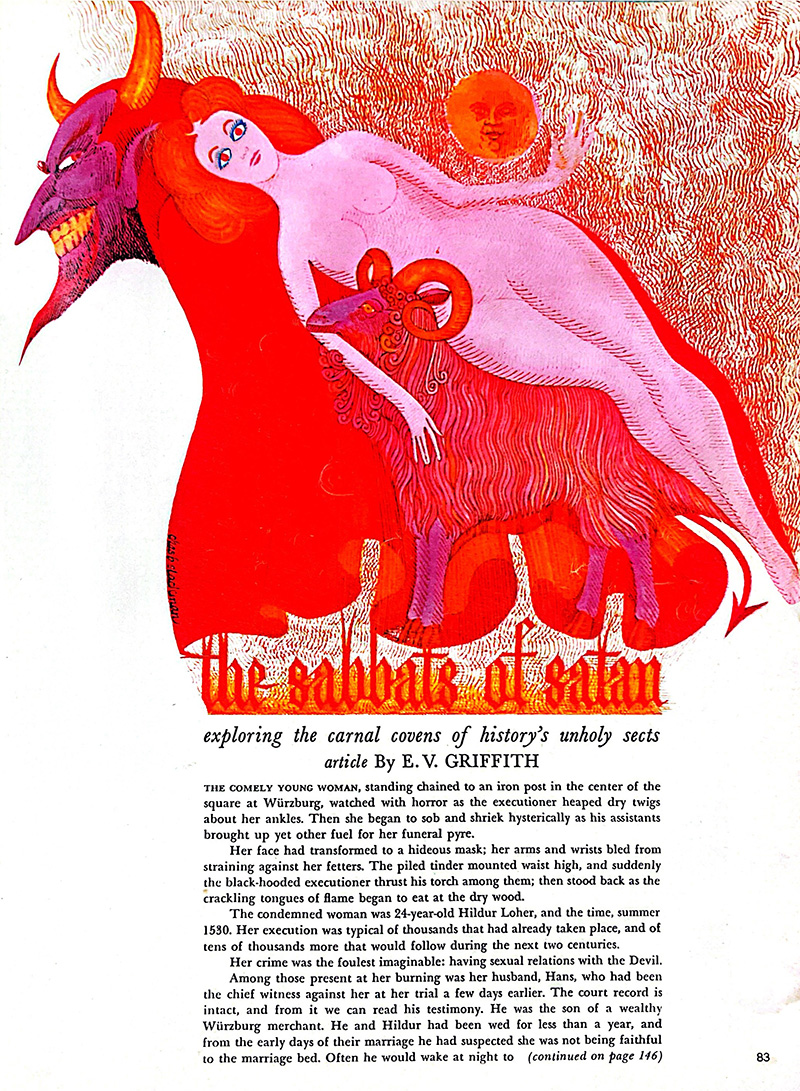
The article, by one E.V. Griffith, is an interesting combination of titillating historical fiction and actual historical information. It begins in media res with a woman about to be burned at the stake in 1530, 24-year-old Hildur Loher:
The comely young woman, standing chained to an iron post in the center of the square at Würzburg, watched with horror as the executioner heaped dry twigs about her ankles. Then she began to sob and shriek hysterically as his assistants brought up yet other fuel for her funeral pyre.
The provocative kicker comes a few paragraphs in: “her crime was the foulest imaginable: having sexual relations with the Devil.”
Griffith then explains how Hildur ended up on the pyre with details and quotes ostensibly plucked from accounts of her witchcraft trial. Hildur would disappear at night, only to return — turn to page 146, flipping past a “salute” to the Playboy Bunnies, an advertisement for silk robes based on the beach cabana scene from Cleopatra, and a satire titled “how to select your second wife” — after dawn. Her husband, Hans, suspected her of having an affair. One night he woke to see her “writhing like a woman in passion, and moaning softly to herself.” When he reached out to touch her, she ran out of the house. He followed her to the edge of the woods, where he witnessed “a score of men and women, seated around a blazing bonfire,” presided over by a tall, naked, hairy man:
Hildur, casting off her nightgown, plunged naked through the circle, and, as Hans reported at her trial later, “That man was the devil, and it was him that she run to.”
This, the article proclaims, was “the dread witches’ sabbat.”
This little vignette, written as though it is quoting from historical documents, is utter fiction. So far as I have been able to tell, neither Hildur nor Hans Loher existed. There were no witch trials in Würzburg in 1530, and witchcraft wasn’t even formally made illegal in the Holy Roman Empire until 1532. There is no trial account from which Griffith could be quoting.
This makes the following section somewhat surprising: a description of witchcraft and its persecution that straddles the line between erotic fantasy and actual historical analysis. Some details would not seem out of place in a dry academic tome, albeit one with a loose sense of accuracy: the Playboy reader can learn about the anti-heresy measures promulgated by Pope Lucius III in 1184, and read misleading statistics about how many people were executed in different years and in which German principalities. But much of the rest is deliberately titillating. The reader discovers that covens were led by a “wizard” who used “the naked body of a young woman as an altar” — before his “amours” with said woman “stimulated the others to wild debauchery.” This wizard’s identity was protected by a two-faced mask called an “ooser,” which held the image of the pagan god Janus on one side and the image of a goat on the other. It was this disguise, along with the intoxication of the participants, that caused the witches to identify this “wizard” as the Devil himself. Griffith even includes an explanation for the report by alleged witches that the Devil’s genitals were unpleasantly cold (a detail that does frequently appear in witchcraft trials). According to Griffith, this was because of a “cold douche given to chill, sterilize, and prevent pregnancy,” delivered via a slender metal instrument that the hallucinating witches mistook for the Devil’s penis.
These may seem like outrageous narrative flourishes. But this exact imagery can be traced to scholars who were not far out of the mainstream of 1960s academia. While Griffith was undoubtedly writing with his audience in mind, it is equally clear that he spent real time doing real research using sources that at the time were at least somewhat academically respectable. One source is particularly evident in the Playboy piece: Margaret Murray, a British Egyptologist who shifted her attention to witchcraft in The Witch-Cult in Western Europe, published in 1921. The book, which was influenced by earlier works like Jules Michelet’s 1862 work La Sorcière and James George Frazer’s 1890 book The Golden Bough, was enormously influential, making Murray the dominant voice in early 20th century witchcraft historiography.
The notion framing the Playboy piece — that those persecuted in the great early modern witch hunts had in fact been members of a surviving pre-Christian fertility cult — came directly from Murray, who was its foremost proponent. Many of the story’s fantastical details can also be traced to Murray or her influences. The animal-mask “ooser” comes from her 1933 book The God of the Witches. The naked young woman as altar is from Witch-Cult in Western Europe, though Griffith added the bit about the wizard’s “amours” with the woman. Perhaps most indicative of Griffith’s method is the “cold douche,” which he adapted from the 1905 translation of Michelet’s La Sorcière, turning a footnote with paraphrased quotations into direct speech from the mouth of a confessing “wizard.”

Murray’s fertility cult theory proved popular not simply because of the tantalizing allure of hidden knowledge and secret societies, but also because it gave agency to the people accused of witchcraft. Previous histories of the great witch persecutions had generally subscribed either to a “conservative” view (that accused witches really had been adherents of Satan and thus had needed to be suppressed) or a “rationalist” view (that the belief in magic was a kind of shared hysteria, both on the part of magic users themselves and the inquisitors who targeted them). Murray turned historical witches from helpless victims of patriarchal violence — indeed, ones who were often assumed to have taken leave of their senses — into active practitioners of an ancient tradition of resistance. She became something of a sensation, publishing several popular books and serving as the president of Britain’s premier folkloristic institution, the Folklore Society, from 1953 to 1955. In 1961, one issue of the Society’s flagship journal, Folklore, was a Festschrift for Murray. She was 98 at the time.
Despite Murray’s ubiquity, her work had serious flaws that were noticed immediately by early reviewers. A 1922 review in Folklore by historian William Reginald Halliday opens with the damning analysis that
If quotations taken from their context may give rise to misleading interpretations, still more misleading is the treatment of a series of documents torn from the background of their own age and divorced from the serious study of their immediate historical antecedents.
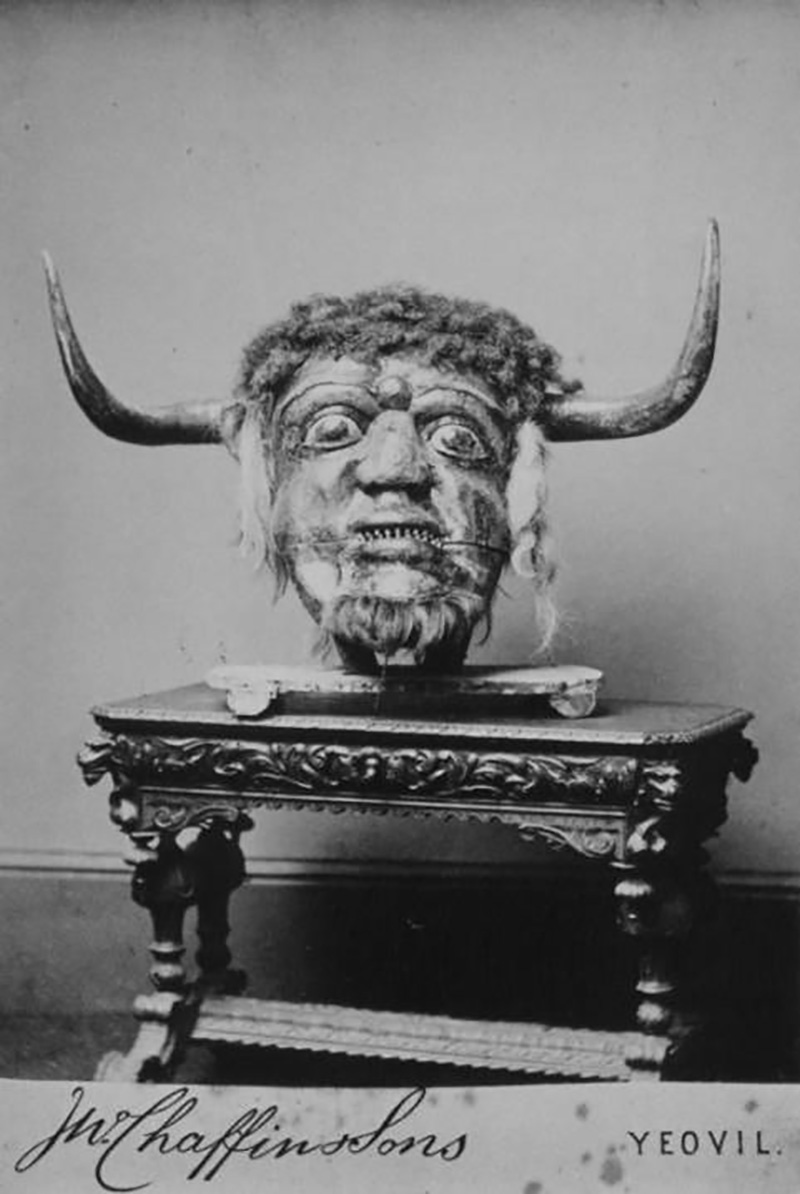
Murray tended to cherry-pick and selectively truncate evidence. She frequently included passages meant to depict witches traveling to or from their meetings, but excised elements that would reveal their obviously fantastical nature — such as the women’s transformation into bees, or the use of a bundle of straw as a “horse.” The “ooser” mask, which Griffith picked up on and included in his Playboy piece, relied in fact on a single English artifact, the “Dorset ooser,” a horned mask of unknown provenance and purpose, to make an argument for the widespread usage of such items in ritual. Another favored tactic was spurious etymology: one particularly egregious example is her denial that calling the witches’ meeting a “sabbath” had any connection to “the number seven” or “Jewish ceremonial,” deriving it instead from the Old French s’esbattre, “to frolic.”
While Murray’s thesis heavily influenced popular perceptions of witchcraft, her views never gained widespread purchase among scholars, who continued largely to hold to the “rationalist” thesis. For whatever reason, however — later retrospectives refer to a “torpor” in British folkloristics at the time — Murray’s views did not come under sustained attack while she was alive, and were further entrenched following her entry into popular history writing. For more than four decades after the publication of The Witch-Cult in Western Europe, Murray was the undisputed queen of witchcraft studies. At the same time, her ideas began to find reception in popular religion, particularly in the new religious movement that would come to be known as Wicca, which entered mainstream culture in 1954, thanks to Murray’s Folklore Society colleague, Gerald Gardner.
At the beginning of the 1960s, the folkloric worm began to turn. Murray celebrated her 100th birthday in July 1963, the same month Playboy published “Sabbats of Satan,” and passed away that November. Just three months later, the historian Rossell Hope Robbins gave a public lecture for the Folklore Society that was, by and large, a sustained attack on the principles of Murrayism. That talk was never published, but retrospective accounts make clear the degree to which the Folklore Society and the nascent Wicca movement were overlapping circles in the 1960s. Folklorist Jacqueline Simpson, who would later publish wide-ranging critiques of Murray’s views, recalled that the 1964 lecture was occasionally interrupted by the caws of a pet jackdaw named Hotfoot Jackson (brought along by Sybil Leek, the most famous witch in the UK) and that before the talk began, she had found a pile of broomsticks in the hall outside (likely a joke by local students). Even as scholarly opinion in the Folklore Society began to turn against Murray’s work, the movement she had influenced remained highly influential within it.
Over the next few years, academic historians from outside the circle of British folkloristics began to publish denunciations of Murray’s theses, beginning with Hugh Trevor-Roper’s The European Witch Craze in 1967. By the 1970s, Murrayism was out, replaced by new investigations that focused on sociological and anthropological explanations for witchcraft beliefs and the ensuing panics. While part of this turn was certainly due to the scholarly shortcomings of Murray’s work, it can also be seen as a backlash against the radical feminist interpretation of history that she put forth. As scholar Mimi Winick pointed out in a 2015 article, one 1922 review accused Murray herself of the very “hysteria” she protested against as an analytical category, a play on words the reviewer seems to have intended as cute. And as Diane Purkiss eloquently argued in her 1996 book The Witch in History, censure of Murray has become something of a shibboleth for witchcraft scholars eager to distance themselves from the radical fringe. “My theories might be pretty out there,” such denouncements imply, “but at least I’m not as wacky as the feminists.”
The turn away from Murrayism was just beginning to percolate when Playboy published “The Sabbats of Satan” in 1963. E.V. Griffith was a writer and publisher, not a historical scholar: it is unclear if his story would have been different if it had been published after Robbins’ speech or Trevor-Roper’s essay. But it is fascinating that this work of semi-fiction, with all its sex and debauchery and lurid detail, came at a time when it was fundamentally not far off the mark of mainstream scholarship. In the feminist historiography of Margaret Murray and the sexual revolution of the 1960s, we can see a strange concordance, the first a theory on its way out, the second a movement just coming into its own. In the same July 1963 issue of Playboy one can find the eighth part of a series titled “The Playboy Philosophy,” written by none other than Hugh Hefner himself. In this particular dispatch, Hefner rails against “religious puritanism” and “religiously inspired sexual suppression” before citing extensively from founding sexologist Alfred Kinsey. “If a man has a right to find God in his own way,” writes Hefner later in the essay, “he has a right to go to the Devil in his own way, also.” In other words, even as the sex positivity imbued in Murray’s scholarship was moving out of the academy in the 1960s, we can see a similar perspective rising in popular culture — here mediated through the admittedly problematic messenger of Hugh Hefner’s Playboy.
E.V. Griffith had his own part to play in this movement. As the head of Hearse Press, he published the literary magazines Sheaf, Hearse, and Poetry Now, as well as a series of poetry chapbooks; these included Charles Bukowski’s first broadside and published collection. In 1970, Griffith edited a collection of poetry titled In Homage to Priapus, a celebration of gay male eroticism including works by authors like Richard Amory and Allen Ginsberg — and one which, between the title and cover art featuring loinclothed men adoring a phallic idol, seemed to convey a decidedly pagan, fertility cult aesthetic. It is possible that as a member of “the counterculture” writ large — which would produce its own moral panic by the end of the ’60s — Griffith felt some kind of affinity for Murray’s witches: not victims of a monstrous and moralistic state, not hysterical women taken leave of their senses, but members of an underground resistance working to overthrow the established order — at least in part through sex. One wonders if 1963 Playboy readers might have seen themselves as part of the same revolution.