
The World War II Stories We Tell Ourselves
Major General Graves B. Erskine talks with John Wayne during the filming of Sands of Iwo Jima, 1949. [Wikimedia Commons]
With estimates ranging between 60 and 90 million dead worldwide, including the 6 million Jews murdered by the Nazis, World War II was the most destructive conflict in human history. But such an abstract description hardly does the war justice. The extent of the catastrophe and the depth of terror, suffering, and misery simply beggars the imagination.
So why is it that World War II has so often been a subject of popular entertainment? It’s somewhat puzzling, but there’s one possible answer: mediated accounts of World War II — at least American ones — tend to conform to the classic pattern of the hero’s journey, which makes for a good story. There is an ensemble of compelling characters (generals, politicians, the average G.I.), a call to action (Axis aggression), a rejection of the call (American neutrality), an inciting moment (Pearl Harbor), an ordeal (three years and eight months of war), a transformation (into a global military-economic superpower), a decisive victory (over Germany, Italy, and Japan), and a final return (a homecoming and a new age of peace and prosperity). These stories typically affirm Americans’ deeply held beliefs about their national character, that we are democratic, industrious, honorable, determined, and resilient. They are what I would call domesticated representations of World War II: representations that aim to tell the whole story of the war in a way that will be comforting to home viewers.
Such is the case with History’s recent docuseries, World War II with Tom Hanks. A 20-part retrospective produced for that network’s commemoration of the American semiquincentennial and billed as a “comprehensive and deeply human portrait of the conflict that reshaped the modern world,” the series depicts the war as a crucible moment for the nation, one whose outcome was determined by the application of our cherished national values and by our willingness to unify behind a single purpose.
And despite its ineffable horrors, when World War II is presented by the nicest guy in Hollywood, an actor and filmmaker whose projects (such as Saving Private Ryan, Band of Brothers, The Pacific, and Masters of the Air) have shaped our collective understanding of that war for nearly 30 years, we can be assured that it will be done with a level of veneration and respect for those who experienced the “good” war. While some of the archival footage that we see may be shocking, Hanks’ presence is meliorating, offering us a calming and friendly presence amid the grisliness of war. With Tom Hanks as our guide, in other words, viewers can be certain that the history of the war will be perfectly fit for domestic consumption.
Viewers get a sense of the character of World War II with Tom Hanks early in its first episode. Those watching are warned by a disclaimer that the documentary will contain violent images of war, and informed by Hanks himself that “the grim reality of the war is almost impossible to comprehend,” only to have the seven-time Emmy award winner add that it will all have a happy ending. Allied soldiers, sailors, airmen, and marines (and really, we’re talking about Americans here), will have endured hell on earth to heroically “liberate enslaved peoples and preserve human dignity.” In doing so, Hanks continues, these men and women (all just kids, he reminds us) “saved that which is most precious and valued by us all, freedom.” Thus does World War II with Tom Hanks, like all narratives, supply a moral interpretation of the events it portrays, which is that the war was an existential conflict in which democratic good vanquished totalitarian evil.
The series’ moral argument is expressed most clearly in the series finale, “Fallout,” which begins with V-J Day and continues to explore the war’s aftermath up to the detonation of the Soviet Union’s first atomic bomb in August 1949. Toward the end of the episode, Jon Meacham, a series executive producer and historian with a reputation for writing uplifting and moralizing interpretations of the American past, explains that the moral and philosophical underpinnings that enabled the Allies to triumph in World War II [were] an appreciation for the individual, support for the dignity of all peoples, a bias for democracy [which] have, for almost a century now, enabled us to live and thrive in a world where Armageddon is always at hand.
But despite this rather upbeat assessment, by revealing that the U.S. would be mired in proxy wars with Communism for much of the 20th century, “Fallout” very nearly casts the outcome of World War II in tragic terms: Victory in World War II radically transformed the foreign policy posture of the U.S. and seemingly obligated it to intervene in a succession of new conflicts. Such a framing has the potential to acknowledge that, in building such a powerful military machine, and in committing itself to multilateral coalitions (the UN, NATO), the U.S., by virtue of its military, diplomatic, and economic preeminence, would forever feel impelled to use force to preserve peace.
Such an assessment of the U.S.’ involvement in World War II would be a new direction for popular interpretations of the war. But it is not quite the message that comes through in the series. Instead, these tragic elements are subsumed into a more romantic mythos, one that is suggested by Meacham’s observation that it was the values of individualism, humanitarianism, and democracy that enabled the defeat of the Axis. And indeed, as Meacham puts it at the beginning of “Fallout,” “one of the great legacies of the Second World War is that a disputatious, complicated, often wrong nation like the United States can, in extremis, marshal significant force to do the right thing.” And although Meacham acknowledges that the U.S. is “often wrong,” there is little in World War II with Tom Hanks that contradicts the official narrative of Americans’ fundamental goodness. Any troubling incidents are rationalized by the righteousness of the cause and the depravity of the enemy. Others are outright omitted.
For instance, aside from a few blink-and-you-miss it moments (a brief mention of segregation and the Tuskegee Airmen, and of the medic Waverly B. Woodson Jr., who treated more than 200 soldiers on D-Day) the series devotes basically no time to the African American wartime experience, the discrimination that Black troops faced on bases, in buses, clubs, and post exchanges, nor of the famous “Double V” campaign. Nor did the series engage with the racism and crass stereotyping that underpinned the war against the Japanese, or the forced internment of some 120,000 Japanese Americans. In fact, the American homefront is barely discussed at all. These omissions are all quite astonishing given the series’ stated comprehensiveness and the evident care that the producers have for their subject matter. Then again, any extended treatment of some of these topics would likely undermine the story of national consensus and moral righteousness that the series was attempting to sell on the nation’s 250th birthday.
But even in those rare moments in which the series acknowledges uncomfortable truths — such as the enormous death toll of strategic bombing campaigns — their inclusion rarely diminishes American virtue. The bombing of Hamburg in July 1943, which claimed the lives of roughly 40,000 German civilians, is one such moment. As we see the grotesque shapes of charred corpses onscreen, the podcaster Dan Carlin recounts how Winston Churchill, after seeing films of the devastation, supposedly said, “Are we beasts?” The question is punctuated by shots of more corpses lying in the streets. Meacham then appears to explain how the advent of air power has effectively made us all potential targets. The implication is that the leaders who would countenance such campaigns can hardly be considered beasts, and that civilian deaths are a regrettable reality of modern warfare — warfare that was forced upon the Allies by German aggression. That the episode notes how Churchill is troubled by the human cost of the operation, moreover, tends to set the Allies on higher moral ground than the Germans, whose war of conquest and elimination clearly did not consider those costs. The Anglo-American bombing of Hamburg thus became if not justified, then at least pardonable, as it was in the service of the greater good of liberation.
What this all adds up to is a telegenic interpretation of World War II, a domesticated interpretation that familiarizes the war, makes its horrors intelligible, and minimizes or omits any historical reality that might complicate its narrative of national unity and consensus.
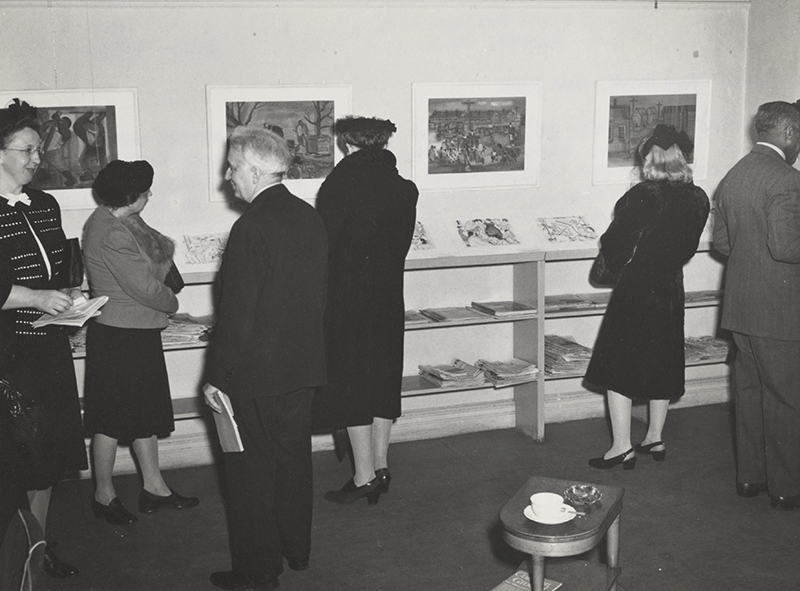
Television has had a hand in domesticating the war ever since the early days of the postwar era. In the spring of 1949, ABC aired a 26-part adaptation of Eisenhower’s 1948 memoir Crusade in Europe. It was produced by the legendary newsreel outfit, The March of Time, and drew from archival combat footage to “picturize” the war and its immediate aftermath. The success of the Eisenhower series led to a sequel, Crusade in the Pacific, in the fall of 1951. The program linked the late Pacific War and the contemporary fighting in Korea in a broader struggle between democracy and totalitarianism in the region. The best remembered of these Golden Age docuseries, however, is probably NBC’s Victory at Sea (1952-53), a joint production with the U.S. Navy that emphasized the critical role that sea power had in winning a modern war, and that won nearly every award for which it was eligible.
Broadcast at a time when tensions between East and West seemed to foreshadow an even more catastrophic war, these series were careful to present World War II in a way that would clarify its meaning, to explain to the home audience what all the trauma and suffering had been about. And though there were differences between them (the March of Time series, for example, took a journalistic approach to history, while Victory at Sea was envisioned as an historical drama), the meaning that came through in all three series was that the U.S. military played a critical role in defending freedom and human dignity.
Like World War II with Tom Hanks, all three were also monumental documentary productions, composed in an elevated style that framed the war as a colossal struggle between irreconcilable ideologies. They were epics of World War II, tales of the “national heroic past,” as the Russian literary critic Mikhail Bakhtin once wrote, that spoke of “‘beginnings’ and ‘peak times’ in the national history,” in this case the formative battle at the dawn of the American Century.
And yet they departed from the classic epic form in one important way. Rather than being cast in tragic terms, as epics have been presented since Aristotle, these depictions have proceeded with a more romantic framing. Where a work like the Iliad centers on the parity of suffering that is caused by the unleashing of force, as the French philosopher Simone Weil famously argued, American WWII epics have tended to deemphasize the effects that the use of force has had on American politics and culture. If, as Weil writes, “the human spirit” is “modified by its relations with force … blinded, by the very force it imagined it could handle,” these latter-day epics suggest that, because of the righteousness of its cause and its own innate exceptionalism, American society can use violence without becoming violent itself.
But the history of the postwar U.S. is hardly a story of swords into ploughshares. While there was indeed a period of demobilization and a waning of support for international alliances after 1945, the rise of the national security state in these years, the correlated expansion of defense and security agencies, and the projection of American power abroad, spoke to a transformation of the American state and an abandonment of longstanding traditions like non-interventionism, antimilitarism, and antistatism.
Clearly, American society had been “modified” (Weil’s term) by its use of force. Given the enduring power of the “Good War” myth in American culture, including as a means of justifying latter-day wars, we would all benefit from mainstream history that refuses to fetishize the conflict, one that troubles comfortable resolutions and is committed to depicting war as tragedy, or one that uses non-narrative or even anti-narrative techniques to decenter what we think we know about the war.
It is unlikely, however, that such an interpretation would be a made-for-TV Hanks production – or that many of us would want to watch it. As Joan Didion once wrote, we tell ourselves stories in order to live. And it’s much easier to live with the comfortable myth than to have to confront the heartbreaking traumas of history.