
Regime Change
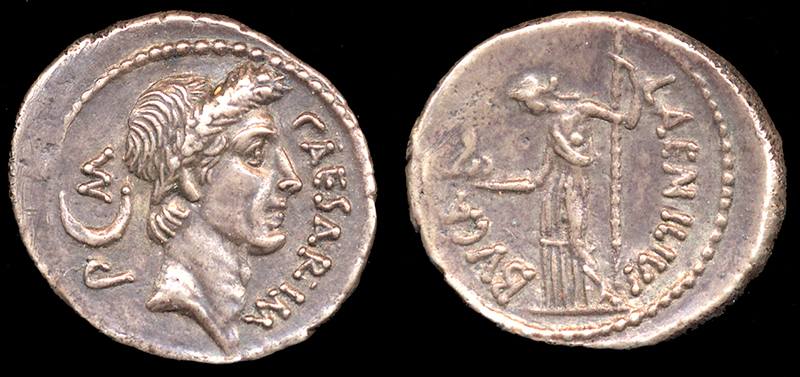
Left: Coin featuring Julius Caesar, 44 BCE. [The Trustees of the British Museum] Right: Coin featuring Donald J. Trump, 2026. [U.S. Mint]
New commemorative coins celebrating America’s 250th anniversary are now on sale from the United States Mint. The coins are part of a series of “golden dollars” (their hue derived from a coating of manganese brass) that first appeared in 2000 bearing the image of Sacagawea. This latest addition features a living person: a stern-faced Donald Trump, facing outward. The word “Liberty” appears above his head along the upper rim of the coin.
Trump’s coin, as many critics have pointed out, seems to violate the spirit, if not the letter, of an 1866 law permitting only the image of deceased persons on bonds, securities, notes, fractional currency, and postal currency. Mint representatives responsible for the Trump dollar coin argue that commemorative coins are exempt under a 2020 law permitting new designs for the nation’s 250th birthday. They cite an example from 1926, when a commemorative half-dollar featuring President Calvin Coolidge alongside George Washington was issued at the Sesquicentennial Exposition in Philadelphia.
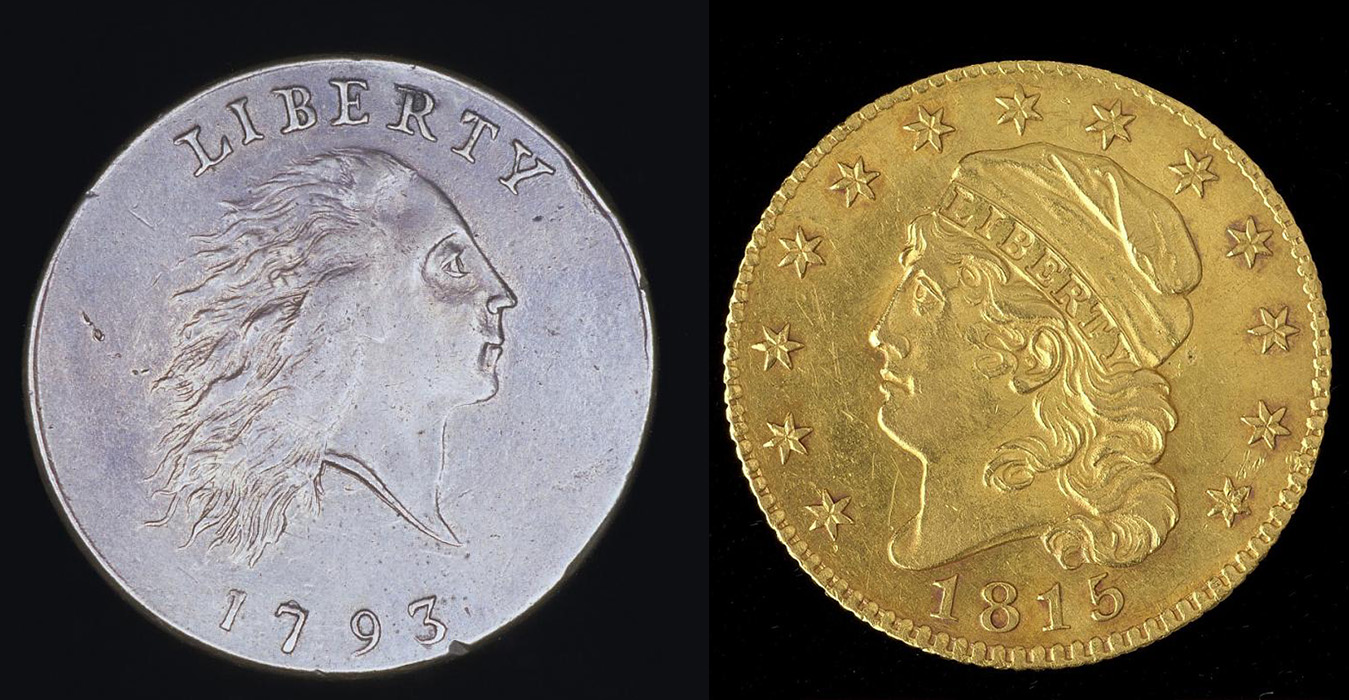
Despite this one (very unpopular) precedent, custom has long rejected the image of living persons on the coins of the United States. The Coinage Act of 1792 clearly defines currency as the place on which the most sacred of American values ought to be enshrined: “Upon one side of each of the said coins there shall be an impression emblematic of liberty, with an inscription of the word Liberty.” Coins were meant to send a powerful message about the American political system and its rejection of individual power in favor of personal freedoms. The contrast between a clear symbol of autocratic rule — the stern-faced Trump — and the message of personal freedom — “Liberty” — shows a disconnect between the ideals of the American founders and the concerted effort of the current administration to redefine long-held national values. This jarring combination of image and text has direct parallels to numismatic messaging from the end of the Roman Republic. In the mid-first century bce, when Julius Caesar became the first living Roman to be featured on coins, the meaning of liberty, coopted and contested, proved a key element in the conflicts that dissolved the Republic and led to the rise of Empire.
For almost five centuries, ancient Rome was governed by a coalition of people and elected magistrates. The Romans called their unique form of government the res publica, “the public affair.” According to Polybius, a historian of the second century bce, it was the Republican system, characterized by a division of power and a system of checks and balances, that gave Rome its competitive edge and allowed one small city in Italy to become a Mediterranean superpower. As in modern America, the success of the Roman Republic relied on a culturally embedded abhorrence of monarchy. Far back in its legendary past, Rome had overthrown its kings under the leadership of a nobleman named Lucius Junius Brutus. The Roman historian, Tacitus, begins his history (the Annales) crediting Brutus with establishing the Republican form of government and “libertas.” Libertas, Latin for liberty, was a deeply enshrined value in Roman society, signifying the people’s power to shape their Republic. Libertas was even worshipped as a goddess in Rome and was commonly featured on coins, depicted holding a cap traditionally granted to slaves when they received their freedom.
Rome’s currency reflected its rejection of autocratic rule. Coins were minted by a rotating group of moneyers who came from the small class of Roman elites making their way up the Roman political ladder. For centuries historians and numismatists have combed through fragmentary literary sources and made detailed studies of Roman coins. Despite this, the exact mechanisms behind the selection and design of numismatic types in ancient Rome is still an open debate. What we do know is that the magistrates must have helped choose the designs, which often celebrated the actions of their own famous ancestors. These designs, however, never featured a living Roman. This was likely not enshrined in law, but rather in custom. The Romans, while they did have laws, did not have a written constitution, but rather acted in accordance with mos maiorum, “the custom of ancestors.”
For the Romans, coins featuring living men were associated too closely with the monarchical systems of the eastern Mediterranean. Since the conquests of Alexander the Great in the fourth century bce, powerful emperors who controlled great swaths of eastern territory were featured on the currency of the cities that they controlled. The Romans knew these autocrats well, having spent much of the third and second centuries bce fighting against them. A few successful Roman generals even went so far as to playact at this sort of power. In 196, in the wake of victories in mainland Greece, the Roman general Titus Quinctius Flamininus created a gold coin with his own face on it. The coin, minted in northern Greece, was never adopted in Rome. In fact, it was tradition that returning generals surrendered their command at the gates of Rome, leaving behind power and influence accrued in far-flung wars. By the end of the first century bce, though, the Republic was in trouble. A series of generals who had amassed fame and riches in their conquests were increasingly reluctant to give up the command of their troops when they returned to Rome.
The trend reached a tipping point with Gaius Julius Caesar. In 49 bce, after accruing massive wealth and popularity from a seven-year military campaign in Gaul, he crossed the Rubicon River and entered Italy, refusing to disband his army. They swept down the Italian peninsula and into Rome. He spent the next few years consolidating his power, eliminating rivals, and reorienting the working of the res publica around himself and his agenda. Both Caesar and his opposition championed the cause of liberty, and in libertatem vindicare, “to set free” became a rallying cry of both sides. This deeply held value to the Roman public easily became, as the great Oxford historian Ronald Syme wrote, “a convenient term of political fraud.” After Caesar’s final victory, the remaining members of the senate decreed that he would be called Liberator and voted to build a public temple to Libertas.
A year later, in 44, the senate named him dictator for life, and Caesar became the first living person to have his face minted on coins in the city of Rome. One of his early moves had been to take over the mint, placing it in the hands of his personal servants. He also expanded political positions to make room for his supporters. Thus the moneyers that year were all friends and partisans of Caesar. The words accompanying his image were not subtle. Caesar, “Dictator in Perpetuity,” read one; “Caesar, Father of the Fatherland,” read another. We cannot know how these coins were interpreted by the average Roman, but for his fellow Romans of senatorial class, they were part of a growing series of authorial oversteps that would seal Caesar’s fate.
A month later, Caesar was dead, killed by a coalition of senators who called themselves the Liberators. At the head of the conspiracy was one Marcus Junius Brutus. Throughout his career, he had minted coins referencing his most illustrious ancestor, the famous Lucius Iunius Brutus who had expelled the kings and brought libertas to Rome. Brutus had long crafted his public persona as a defender of the basic political rights of the Republic. One early coin pairs an image of the first Brutus with a goddess Libertas. Another, minted in exile from Macedon after Caesar’s death, features a freedman’s cap between two daggers. The legend, “The Ides of March” refers to the day of Caesar’s assassination. The meaning is clear: In a Republic, autocratic rule is the enemy of libertas.
The assassination of Caesar did little to preserve the Republic. His cause was immediately taken up by a coalition of successors: his right-hand man Marcus Antonius (Mark Antony) and his nephew, Octavian, banded together to fight the assassins, whom they defeated in Greece in 39 bce. Octavian and Antony, who soon turned against each other, both used the concept of Libertas in the battle for public approval. Octavian had the final word. In 31 bce he defeated the combined forces of Antony and the Egyptian queen Cleopatra, establishing himself as the dominant power in the Roman world. In the wake of the battle, he minted a coin naming himself Libertatis P R Vindex, “Defender of the Liberty of the Roman People.”
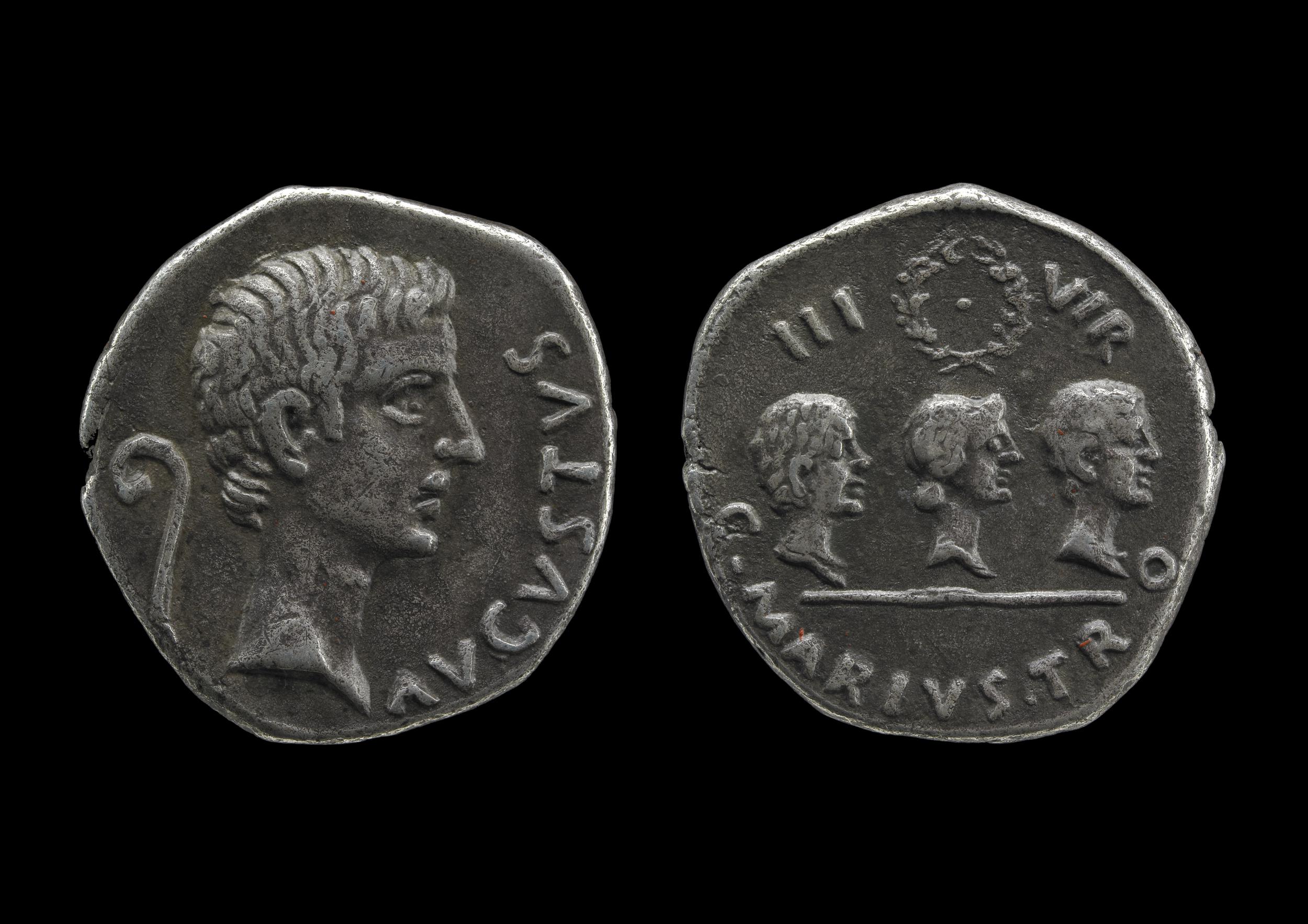
A decade later, he would take the name Augustus, “The Magnificent.” His enemies defeated, he took control of Rome and declared the res publica restored. He was Rome’s first emperor. Before his death, Augustus prepared his own funeral oration for public display — a long list of things accomplished throughout his career. He began with his arrival in Rome after the assassination of Caesar. In his version of the story, he came to restore libertas in a time when the assassins of Caesar had brought great risk to the res publica: “At the age of 19, on my own initiative and at my own expense, I raised an army by means of which I restored liberty (libertas) to the republic, which had been oppressed by the tyranny of a faction.”
From Augustus onward, coins across the Mediterranean featured the bust of the living emperor. Taking cue from Augustus, the imperial family gave Libertas a central role, restoring her temples, erecting statues, and featuring her on coins. By the time of the third emperor, Claudius, coins showed a new name for the goddess, Libertas Augusta, “Augustan Liberty.” When the Republic fell, it was not only the form of government that changed in Rome, but the very definition of liberty. No longer did it symbolize freedom from autocratic rule, but rather it became a symbol of the protection that only autocratic rule can provide.
The new commemorative coins are part of a larger strategy by the Trump administration to redefine liberty and, in doing so, reshape the American Republic. When Representative Martin Russell Thayer of Pennsylvania proposed the currency amendment in 1866 — a reaction to a Treasury official minting his own face on a series of 5-dollar bills — he cited the example of the Roman Republic in words that now seem prescient: “When we shall have a living Caesar to make both the laws and the money of this country it will be time enough to place his effigy upon the coins and notes of the United States.”
The portrait of a living individuals on American currency sparked comparisons to Caesar in 1866, and the immediate connection to autocratic rule has not faded. In a reaction to the Treasury’s plans, two democratic senators, Nevada’s Catherine Cortez Masto and Oregon’s Jeff Merkley, introduced for a new law that clearly extends the 1866 prohibition to all and any future U.S. currency. “President Trump’s self-celebrating maneuvers are authoritarian actions worthy of dictators like North Korea’s Kim Jong Un, not the United States of America,” said Merkley.
Long at the heart of American political rhetoric, “liberty” has been a fixed message on American numismatics since 1793, when the first copper cents that were minted featured an image of Lady Liberty. The end of the Roman Republic, however, teaches us not to see the writing above Trump’s portrait as mere adherence to custom. Alongside Trump’s cryptocurrency initiative, “World Liberty Financial” or his Department of Justice’s “Religious Liberty Commission,” these coins actively work to depict Donald Trump as the defender of a new brand of American liberty, centered on himself and defined in opposition to political dissent. The power of this message lies in the public’s own forgetfulness and disregard for the historical precedents so well-studied — and feared — by the American founders. When the people give the power to define and grant liberty to one powerful individual, they risk losing it entirely.