A Danger to Civilization
Theodore Lothrop Stoddard was one of a generation of American thinkers who worried that the United States had gone too far in its egalitarian enthusiasms. His intellectual allies included writers such as Madison Grant (Stoddard’s mentor and author of The Passing of the Great Race) and Duke University psychologist William McDougall (Is America Safe for Democracy?). They shared a conviction that people were separated by blood, biology, and race into distinctive categories that formed a hierarchy that ought to be reflected in society — and would be, if no meddling reformers got in the way. In their eyes, the myth of equality was a sentimental, utopian fiction promulgated by malign conspirators who intentionally sought to degrade society only so that they could take power.
Most treatments of Stoddard, Grant, and the other eugenicists emphasize their role in popularizing “scientific racism” in America. Racist thought — the belief that humanity is not a single species but is separated into genetically distinct races, and that the white race is a superior biological entity — certainly was at the heart of their intellectual project. But to view their philosophical racism as merely a simple, if extreme, form of prejudice or as an expression of fears of cultural change is to misunderstand the nature of their thought and its political implications. What made them exceptional in the American context was not only their racial prejudice, which was widely shared among many white Americans, but the logic of their argument for dispensing with egalitarianism and democracy across the board.
These were not fringe thinkers. For most of the teens and 1920s, they were thoroughly in the mainstream of American political and intellectual life. As a journalist and popular historian, Stoddard had to be acutely sensitive to cultural trends so that he could make his living writing books and articles capable of commanding the interest of editors and the attention of a mass audience. What defined his thinking, and that of the others in his circle, was its rejection of any vision of an underlying, essential equality of human worth as weak, sentimental, and false — a danger to civilization. For Stoddard, race was part of a larger system of hierarchical thinking about what kind of people deserved to perform what kind of work and who deserved to benefit from their exertions.
For Stoddard as a young writer, his convictions shaped already by his work on Haiti, the world of scientific racism would have seemed easily accessible and the professional rewards for participating in it considerable. After arriving in New York, he became a member of the Galton Society, an exclusive private club for the promotion of eugenics. It is probably through this connection that he got to know Madison Grant well enough that Grant wrote a foreword to Stoddard’s 1920 book, The Rising Tide of Color Against White World-Supremacy, which called on the white world to embrace a spirit of confrontation and challenge, to maintain its political and economic power.
Stoddard began by framing the historic contest of the moment in terms of World War I. The Great War, he argued, had been an “internecine death-grapple” between rivalrous groups of white Europeans, which had been greeted with astonishment by the colonized peoples of the world. Prior to the war, Asia and Africa had been cowed by “fear of white power” and by the “magnitude of the task involved in overthrowing white supremacy.” But in the war, this “respect for white civilization” had dropped away “like garments outworn,” leaving behind the “mingled exultation, hate, and scorn” of “every portion of the colored world.” Stoddard cited W.E.B. Du Bois and Japanese poet Yone Noguchi (father of sculptor Isamu Noguchi) as examples of thinkers who were no longer simply willing to accept the tutelage of Europeans. He called for “white solidarity” to meet the “crisis of the age.” “Decisions — firm decisions — must be made. Constructive measures — drastic measures — must be taken … Else — Swift oblivion in the dark ocean.” Grant echoed these warnings in his introduction to Stoddard’s book, opining that democracy was “suicide pure and simple” in an interracial society.
The Rising Tide of Color was the smash hit of which Stoddard had dreamed, winning accolades from academics and the general public alike. It was a bestseller and went through multiple printings. Scholars praised the book, including the acting president of the American Academy of Political and Social Sciences, who solicited a piece on immigration by Stoddard for the annals of the academy. The Saturday Evening Post lauded the book and recommended it to “readers who can face without wincing the impact of new and disturbing ideas.” Political figures commented prominently, endorsements that its publisher (Scribner) then used for promotion. Senator James Vardaman of Mississippi, a leading white supremacist Southern Democrat, recommended it to President Warren G. Harding and suggested the formation of a committee to study the problem of race in the South that would include Stoddard and Madison Grant (Vardaman struck up a correspondence with Stoddard as well). Unlikely intellectuals expressed their appreciation of Rising Tide, including the Harlem socialist and radical Hubert Harrison, who reviewed the book for Negro World and corresponded with Stoddard following its publication, describing it as “unrivalled” as a work of international journalism, even though, he wrote, “Naturally, since I am a Negro, my sympathies are not at all with you: that which you fear, I naturally hope for.”
In Stoddard’s greatest coup, President Harding referred to his book in a speech in Birmingham, Alabama, celebrating the fiftieth anniversary of the city’s founding: “Whoever will take the time to read and ponder Mr. Lothrop Stoddard’s book on ‘The Rising Tide of Color’ … must realize that our race problem here in the United States is only a phase of a race issue that the whole world confronts.”
The Rising Tide of Color was published shortly after a wave of extreme violence against African Americans in East St. Louis (1917) and Chicago (1919). It helped both to justify and to inspire the revival of the Ku Klux Klan, which was gaining momentum and members in the North and Midwest. The book, part of a larger intellectual subculture of “scientific” racism, crystallized the reaction against racial equality in the aftermath of World War I.
Many other writers at the time (most of whom have since been forgotten) echoed Stoddard’s themes, warning that a racially mixed society had to limit democratic politics. Any other possibility exalted a sentimental ideal of natural rights over the brute reality of inequality. For example, the author Alleyne Ireland warned in a 1918 essay in the Journal of Heredity that “the accepted facts of heredity” explained the inefficiency and limits of democratic government. Only “our blind acceptance of a religious doctrine — the natural rights of man — as a religious principle” led people to insist on the merits of democracy, when a realistic appraisal showed that those societies were the best in which the fewest people had a say in their affairs and operations. William McDougall wrote in his 1921 book Is America Safe for Democracy? that some people were more “valuable” than others, a cold fact that had to call the principle of democracy into question: “If Nature has made men of unequal value, the cruelty is hers, not ours . . . we do no wrong in ascertaining and recording the facts.”
Stoddard wrote two books in rapid succession in the years that followed the success of Rising Tide. The first, The New World of Islam (1921), identified politically charged Islam as a radicalizing force in the Muslim world, which was inculcating a “reactionary hatred” of Western civilization, and predicted that a clash between Islamic nationalism and Bolshevism would dominate the politics of the Middle East for some time to come. But it was Stoddard’s next popular book — The Revolt Against Civilization, published again by Scribner in 1922 — that made the fullest case that the future of civilization required the preservation of social hierarchy. Hierarchy was the ideal condition of humankind, Stoddard argued, and it had to be accepted and embraced for civilization to cohere at all. The core reason race mattered was that it assigned to people their place in the economic hierarchy — and preserving racial divisions was necessary to guarantee that people kept doing the work they were supposed to do.
In The Revolt Against Civilization, Stoddard was responding to the world developments that accompanied the end of World War I — most notably the Bolshevik Revolution in Russia; the formation of the Third International, or the Comintern, which sought to unify communist parties around the world under the direction of the Soviet Union; and the strikes and social unrest that swept through the United States at the end of the 1910s. His earlier work had presented an image of the rest of the world rising against America and Europe — the white West. But in The Revolt Against Civilization, he imagined that the greater danger came from within. Borrowing heavily from Nietzsche, he presented humanity as divided between the Under-Man, driven by his resentment and hatred predicated on his awareness of his own inferiority, and the Over-Man, whose nobility and capacity to act set him apart. In ordinary times, the Under-Man could be controlled by the prison and the scaffold, as Stoddard put it. But in moments of social breakdown — as in the First World War — he would burst to the surface in a spirit of “atavistic revolt.”
The Revolt Against Civilization opened with a stark depiction of human civilization as “fundamentally conditioned by race.” The “backward peoples of the earth,” as Stoddard called them, would always seek out the centers of civilization, drawn to their ease, material wealth, luxury, and comfort. But these lower races remained “uncivilizable,” and what was more, they hated and resented the very civilized society that nurtured them. “Every society engenders within itself hordes of savages and barbarians, ripe for revolt and ever ready to pour forth and destroy.”
The great danger for Stoddard was the philosophy of “levelling equality,” which he believed was the rallying cry of the Under-Man. “Natural equality,” he wrote, “is one of the most pernicious delusions that has ever afflicted mankind,” a “figment of the human imagination.” There was a natural “Law of Inequality as universal and inflexible as the Law of Gravitation.” Science, biology, and eugenics all showed that this was the case, that heredity and not environment shaped human character. From Stoddard’s point of view, the Bolshevik Revolution challenged this incontrovertible truth. Modern society had bred a class of people who resented and feared the inequality that modern science showed was the undeniable reality of life. In the past, pleasant dreams of universal human equality might have pacified the Under-Man, but the present was different: “Now that Nature herself proclaims him irremediably inferior, his hatred of superiority knows no bounds.”
The result was an inherently unstable social order, for the Under-Man was perpetually dissatisfied, constantly ready to tear down his superiors. For Stoddard, the most serious threat posed by the Under-Man was not biological (that he would reproduce and in time outnumber his superiors) but political: “Let us, then, understand once and for all that we have among us a rebel army — the vast host of the unadaptable, the incapable, the envious, the discontented, filled with instinctive hatred of civilization and progress, and ready on the instant to rise in revolt.” Understanding heredity and biology, for Stoddard, meant acknowledging that democratic government was an impossibility: “Democracy was never intended for degenerates, and a nation breeding freely of the sort that must continually be repressed is not headed toward an extension of democratic liberties.” Tracing out the logical consequences of the rejection of human equality as an ideal, Stoddard suggested that democracy should be replaced by “neo-aristocracy” as the standard for humankind. Preaching about equality and democracy would only inspire social turmoil, for it would “[stir] the little-brained to hope for an impossible leveling of human beings.”
Despite the enthusiastic reception for The Revolt Against Civilization, the book was not the runaway hit that Rising Tide of Color had been. Nothing Stoddard did afterward garnered the same attention. His reception had depended entirely on the presence of a movement eager for what he had to say; once that waned, few were interested.
Stoddard kept trying to recapture the spotlight he had had for Rising Tide of Color. In 1927, he published Re-Forging America, a popular retelling of American history in which he presented the American Revolution as hopelessly influenced by the French, who were to blame for the bold statements about equality. Absent these, he asserted, separation from Britain would have happened with far less bloodshed and would not have alienated many of those who would otherwise have been the leading citizens of the country. Looking at the contemporary United States, Stoddard suggested that Jim Crow (then formally restricted to the South) should become a national system of segregation. He termed this “bi-racialism,” calling it “the key to social peace” and envisioning the adoption of apartheid laws on the national level under which black and white Americans would be separated politically, socially, and culturally. Black people under this system might be given limited political rights, but only over their own separate institutions. The idea met with enthusiasm from people like Alabama Senator Hugo Black (who would later become a Supreme Court Justice), who wrote in a letter to Stoddard, “As a son of the South, it is a pleasure to tell a son of New England, that I believe your national doctrine to be worthy of the admiration of every loyal American.”
In a series of appearances that seemed simultaneously a measure of his declining confidence and his eagerness to hold the public eye in whatever way he could, Stoddard participated in debates in the late 1920s with Harlem Renaissance leader Alain LeRoy Locke and W.E.B. Du Bois. Du Bois had long been coolly dismissive of Stoddard, writing (accurately) in 1923 that “Lothrop Stoddard has no standing as a sociologist … He is simply a popular writer who has some vogue now.” In 1929, Stoddard challenged Du Bois in Chicago on the topic of “Shall the Negro Be Encouraged to Seek Cultural Equality?” Du Bois would take the affirmative, Stoddard, not surprisingly, the negative.
Du Bois, who was at that time sixty-one, calmly demolished the argument that black people should be excluded from cultural equality, which he interpreted to mean their full, active engagement with cultural and intellectual life.
“What could you conceive as better than a world in which all the citizens of that world were not only encouraged to seek cultural equality, but accomplished it?” Du Bois asked. At an earlier point in time, Du Bois argued, the white position had been that black people were simply incapable of participating in a shared cultural or intellectual life: “In the early days, they said, and said frankly, ‘No, you shouldn’t encourage the Negro to cultural equality, because he cannot reach it: he is not really human in the sense that other people are human.’ ” Emancipation and the strides toward black equality in the North had made this frank position harder for whites to take. Instead, people like Stoddard continued to resist equality, but with a twist: “They would say that the coming forth of these people does not mean they can make as great a gift to culture as the white people have made, but, whether they can or not, they must not be allowed to come forward, because it threatens civilization” — as though civilization was a zero-sum game, in which there was never enough to go round. The real issue, Du Bois argued, had nothing to do with protecting high ideals; at stake was simply ensuring the brutal ability of white people to dominate and exploit black Americans.
The Chicago Daily Tribune did not cover the event, but the headline in The Chicago Defender, a black newspaper, left no doubts about who had won the day: “Du Bois Shatters Stoddard’s Cultural Theories in Debate.” The Baltimore Afro-American was even more direct: “5,000 Cheer W.E.B. Du Bois, Laugh at Lothrop Stoddard.”
Though his cachet was dwindling rapidly, Stoddard continued writing, trying to make his reactionary faith relevant again to a broad audience. With the rise of fascism, he thought he might have found a new way to provoke attention and win readers — recognizing in it something akin to the belief in fundamental inequality he had long promoted. In 1927, five years after the March on Rome that brought about the resignation of Italy’s sitting prime minister and the ascension of Benito Mussolini, he wrote a short piece on fascism in Harper’s arguing that it was time to take a fresh look at fascist thought as a bracing corrective to America’s sentimental illusions. What appealed to Stoddard about fascism was that it “assailed the idol” that “all men are created equal.”
Not all of Stoddard’s later writings were as politically pointed as his appreciation of fascism, but they were about as poorly timed. He published a book about luck on Friday, September 13, 1929 — shortly before the collapse of the stock market. He brought out a follow-up to Rising Tide called Clashing Tides of Color, which revisited many of his old racial concerns. By this time, the tone of American opinion had shifted so considerably that the book — while still well received in England — was roundly condemned in the American press. Nonetheless, Stoddard was still within the bounds of the respectable. He was occasionally invited to give commencement addresses and the like at conservative institutions — for example, he spoke to the graduating seniors at Virginia’s Staunton Military Academy in 1938.
This changed with the rise of Nazism. In 1939, Stoddard traveled to Europe to report on Germany at the start of the Second World War. He imagined that he might be able to write a bestselling account of Nazi rule, boasting that he would approach the subject with an “open mind” and an “objective attitude.” He interviewed Goebbels, Göring, Himmler, and Hitler. When he met Hitler, he described his “firm handshake and pleasant smile,” writing that the “Master of Greater Germany” was in good health, calm, fit, and poised, although less charming than Mussolini, whom Stoddard had also personally met. Publishing apologetic newspaper pieces as he prepared his longer book of reportage on the Nazi regime, he reprinted Goebbels’ claims that England made a grave mistake when it presented the conflict with Germany as one between democracy and dictatorship. “Isn’t the National Socialist Party essentially the German people? Are not its leaders men of the people?”
His final book — a travel guide to Nazi Germany in the year after Kristallnacht — had a disconcertingly jaunty tone. “My first meal in the Third Reich was a distinct success,” Stoddard reported. “As might have been expected in this pre-eminent Nazi hostelry, the food was good and the service quick.” He described Himmler as “the redoubtable head of the Gestapo,” and interviewed him about the “resettlement policy” of the Jews, noting that Himmler carefully avoided talking about “the tragic aspects” of dislocation, expropriation, and concentration camps this policy involved. Berlin, Stoddard wrote, was “one of the safest cities in the world for even the most prosperous-appearing person” — thanks to the Nazis’ tough-on-crime policies.
Writing as a detached observer of Nazi social policy, Stoddard chronicled with approval his visit to a eugenics court, where he could see his ideas about “the modern science of eugenics, or race betterment” put into practice. “The Jewish problem is regarded as a passing phenomenon,” he wrote, “already settled in principle and soon to be settled in fact by the physical elimination of the Jews themselves from the Third Reich.” (What that elimination meant Stoddard did not specify — nor, of course, did he offer any objection to the deportation of Jews to camps or to the widespread racist laws that were already firmly in place by the time of his visit to Germany.) Nazi eugenics — which Stoddard breezily described as “the most ambitious and farreaching experiment in eugenics ever attempted by any nation” — was in his view primarily concerned with replenishing the racial stock of the nation, “in a bad way” at the start of the Nazi years. Stoddard came away with a positive impression of the eugenics court, writing that the “painstaking, methodical” approach of the proceedings left him convinced that “the law was being administered with strict regard … if anything, judgments were almost too conservative” — but that it was “weeding out the worst strains in the Germanic stock in a scientific and truly humanitarian way.”
Stoddard immediately recognized that the eugenics court was akin to his own political project. That he could extol it shows how shallow his moral understanding was — but it also points to his complete misreading of the political dynamics of 1940, his misplaced confidence that scientific racism would still command the support of a large part of the American public. At the same time, he did recognize that by 1940 popular opinion in the United States would no longer embrace open declarations of sympathy with Hitler, and he permitted himself a few snipes at the Nazi leader. Hitler, he complained, refused to let him quote their interview directly. The Nazis were “fanatical zealots,” quite “unscrupulous in their methods.” He wrote of returning to the United States and feeling a sense of relief to be once more among people who were not “worried and harassed and ulcerated by nationalistic hatreds.” Not that it mattered: Into the Darkness quickly disappeared into darkness and obscurity itself. Stoddard’s last bid for popularity was a pathetic failure.
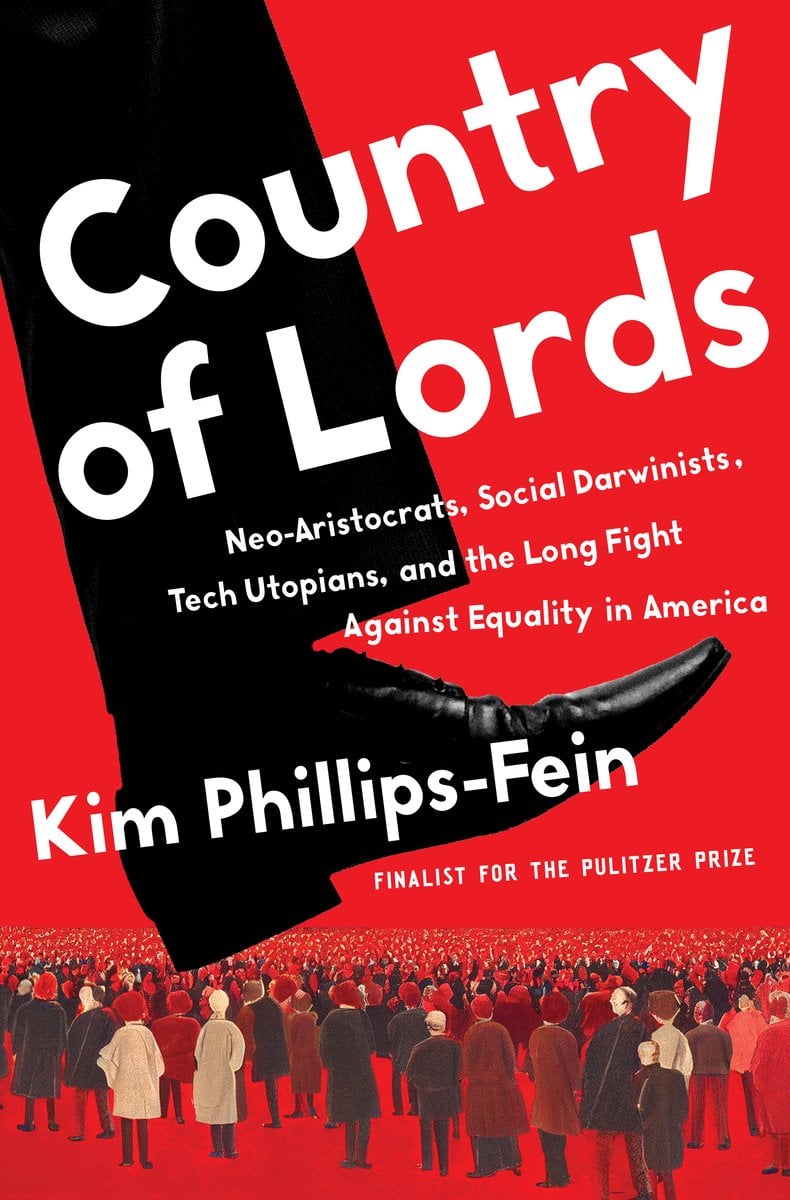
Adapted from Country of Lords: Neo-Aristocrats, Social Darwinists, Tech Utopians, and the Long Fight Against Equality in America. Copyright © 2026 by Kim Phillips-Fein. Reprinted with permission of W.W. Norton & Company, Inc. All rights reserved.