
A Different Kind of Historical Labor
One of Gebremeskel Tesema’s completed rock-hewn churches in Gashena, 2024. Photograph by Jaclynn Ashly.
Tucked within the rocky mountains of Ethiopia’s northern Amhara region, a fortysomething monk decided to dedicate his life to bringing medieval history into the present.
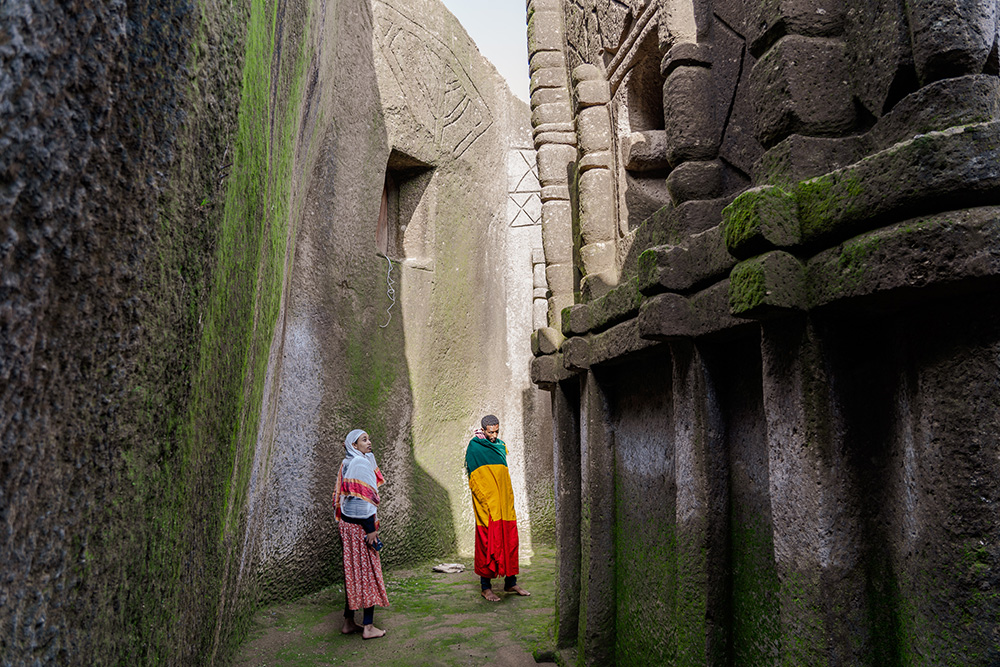
In 2011, Gebremeskel Tesema set out to carve 11 free-standing monolithic rock-hewn churches outside the town of Gashena. He is believed to be the only person in the world known to still be creating such churches, which are made from chiseling a free-standing structure out of a single block of stone. Workers start at the top, carving down until a giant cube of solid rock remains, surrounded by a trench. They then move inward, excavating doors, windows, and other features.
“This represents our politeness and submission towards Jesus Christ because He came from up to down to teach us and save us,” Tesema told me. Michael Gervers, a professor at the University of Toronto, noted this method is also practical, as it eliminates the need for ladders.
Eschewing modern measuring tools, Tesema relies solely on his forearm or a piece of string, and he never draws or maps his designs in advance. Two church deacons assist him, using the same simple tools likely employed by carvers for centuries. It should only take one year to finish each church, he says; however, disputes with the local church administration have slowed his work.
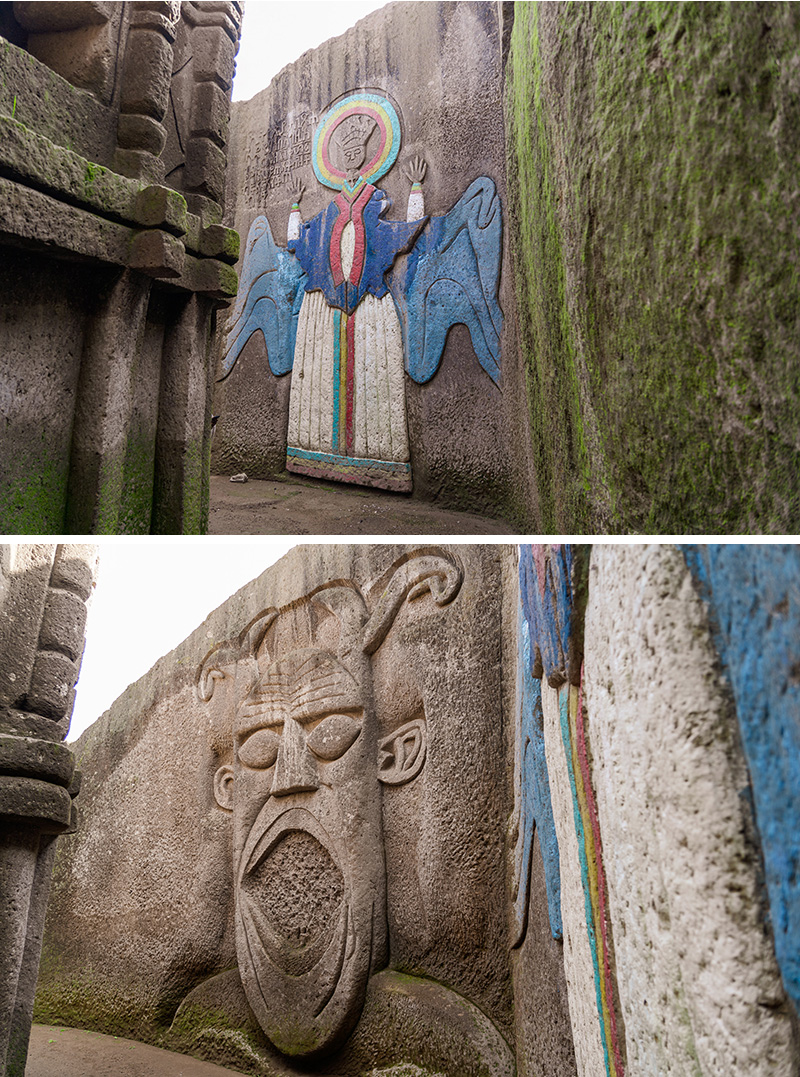
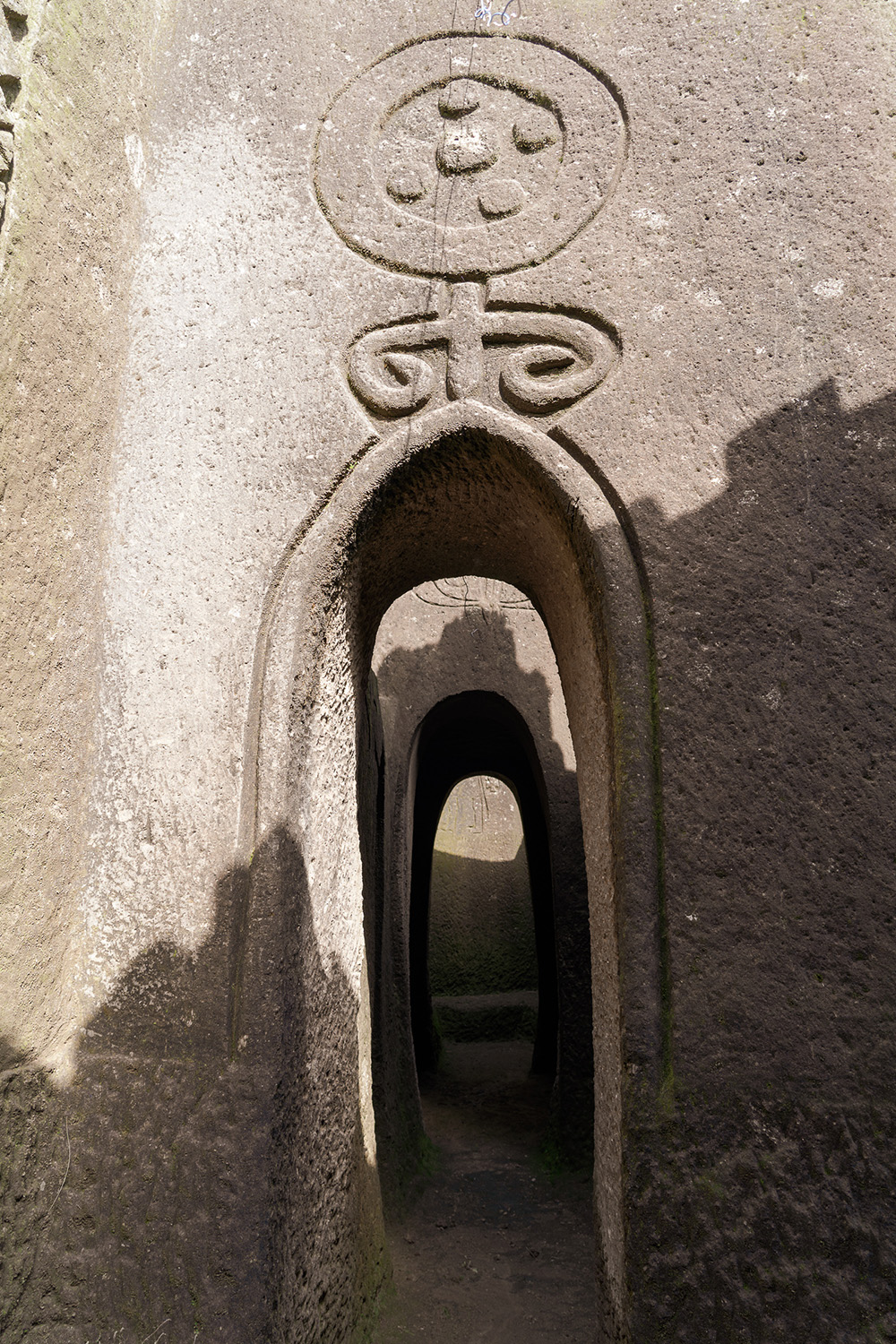
Tesema tackles the churches’ intricate carvings alone. Sharp, angular lines and geometric motifs trace the walls and entrances, while the interiors are filled with sacred imagery — crosses, ceremonial drums, and scenes of the Last Supper. In the courtyards, animals and plants appear alongside figures drawn from Egyptian and Greek traditions, including a striking sphinx.
His work is part of a larger rock-carving tradition that remains a living Christian practice in northern Ethiopia. According to Tsegaye Ebabey, a researcher at Addis Ababa University, the tradition is widely believed to have declined and nearly disappeared in the 16th century following the Ethiopian-Adal War (1529–1543), with a revival emerging in the late 1980s and 1990s, though this exact timeline is still the subject of debate. Within this long and rich tapestry of northern Ethiopia’s rock-hewn churches, Tesema stands out. “He’s certainly the most unique of the rock carvers in Ethiopia,” Gervers says, because he is the only contemporary carver creating new monolithic churches from entirely original designs, reshaping rather than just preserving the tradition.
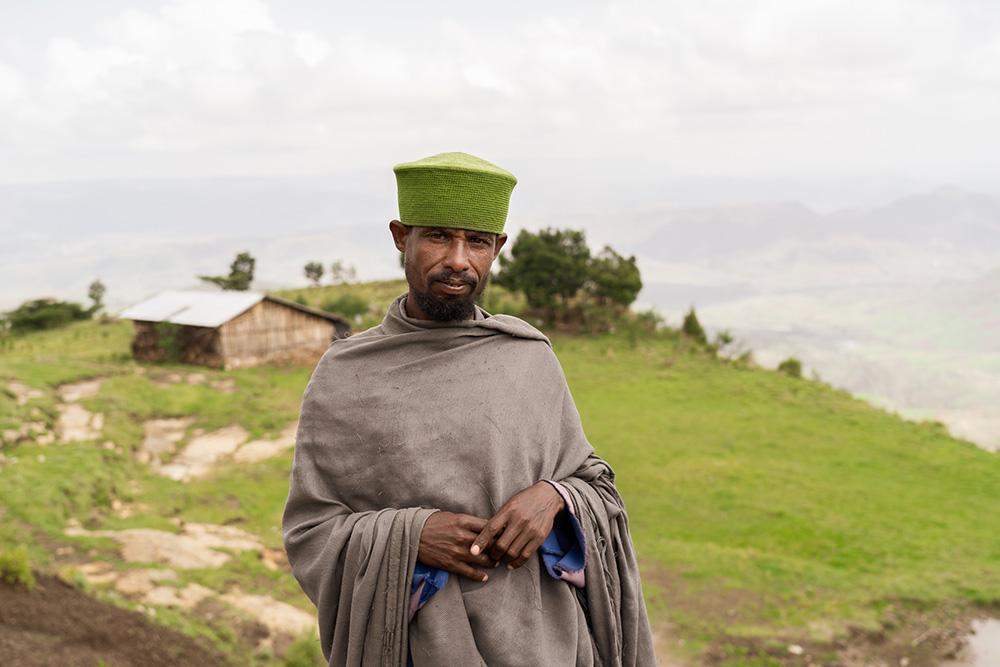
Tesema’s carving experience comes entirely from building these churches. He has built five churches already, and calls his work Dagmawi Lalibela, or the “Second Lalibela,” in honor of the 11 monolithic churches nearby that inspired his work.
The original Lalibela churches, showcasing ingenious designs, sophisticated carvings, and complex engineering, were named a UNESCO World Heritage site in 1978. The Lalibela churches are immense; Biete Medhane Alem is believed to be the world’s largest monolithic rock-hewn church. Their creation transformed a small mountain town into an underground holy fortress, which continues to draw tens of thousands of pilgrims each year, especially during major Ethiopian Orthodox Christian festivals.

“These churches serve as proof of the existence of God,” Tesema told me. “When the wind blows, you cannot see it, but you feel its touch and watch it move the trees and clouds. In the same way, God’s spirit is unseen, yet becomes visible through works done in His name.”
Ethiopian Christians believe that the Lalibela complex was created by King Gebre Meskel Lalibela, an important saint in the Ethiopian Orthodox Christian tradition, in the 12th and 13th centuries as a new home for Christianity in the Ethiopian highlands after Jerusalem was recaptured by the Muslim leader Salah al-Din in the 12th century.
According to the Gadla Lalibela (Acts of Lalibela), a 13th–14th century Ge’ez text, King Lalibela created the churches in 24 years with heavenly aid, carving by day while angels completed the more difficult work at night. While many followers of the Ethiopian Orthodox Tewahedo Church believe King Lalibela worked with only a few helping hands, this text records that he oversaw a substantial workforce of paid laborers, highlighting the scale and organization of the project. Followers of the Church maintain that King Lalibela was guided in a dream by Jesus Christ, who revealed the designs for the holy complex. “If I [also] had experiences like this,” Tesema said, “I wouldn’t tell anyone.”
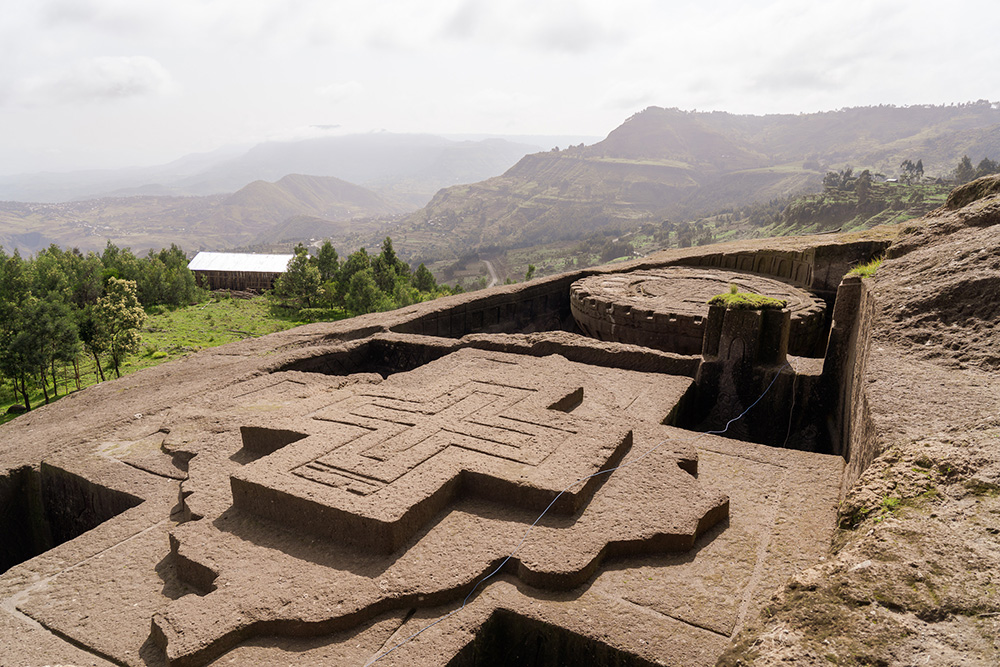
Archaeologists argue for a much more complex, multi-phase history of the site, of which Tesema’s Second Lalibela is the latest addition. His bold departures from convention and innovations are what most strongly connect him to Lalibela’s legacy. “His project is similar to Lalibela in the sense that it is very unique and remarkable,” says Mikael Muehlbauer, a specialist in the architecture of medieval Ethiopia and author of the 2023 book Bastions of the Cross: Medieval Rock Cut Cruciform Churches of Tigray, Ethiopia. “He’s clearly an artist and a genius. He’s not just following tradition. He’s doing something completely new and it’s quite radical. I’ve never seen what he’s doing in my life.”
This novelty, according to Muehlbauer, lies not in the carving itself but in what he makes with it: while the technique is inherited, Tesema’s artistic forms have no historical precedent, transforming the tradition from within. Tesema himself also helps broaden scholars understanding of this history by serving “as an existing example to understand this ancient carving tradition in Ethiopia,” said Ebabey.
The scholarly understanding of Lalibela has shifted dramatically since Portuguese explorer Francisco Álvares introduced the site to Europe in the 1520s. Álvares was so overwhelmed by the architectural sophistication of the complex that he immediately dismissed Ethiopian authorship. He attributed the structures instead to Egyptians — whom he often viewed, through a Eurocentric and colonial lens, as “White men” or carriers of foreign technical expertise, according to Muehlbauer.
Over time, European scholarship moved from embracing Álvares’ foreign-origin explanation to accepting, with little critical scrutiny, the Ethiopian Orthodox belief that King Lalibela completed the churches in a miraculous 24-year span.
The 14th-century Ethiopian Orthodox epic Kebra Nagast — “The Glory of the Kings” — claimed that Ethiopia’s monarchy descends from the union of the Queen of Sheba, Makeda, and King Solomon, and that their son, Menelik I, brought the Ark of the Covenant to Ethiopia, establishing the nation as a divinely chosen “New Israel.” The Ethiopian Orthodox Tewahedo Church holds that Menelik became the first emperor of historic Ethiopia thousands of years ago, establishing the Solomonic dynasty.
King Lalibela was part of the Zagwe dynasty, which rose to power in the 12th century and traced its legitimacy to King Solomon as well, but through a different line — claiming descent from Makeda’s maid, who was said to have also borne a son to Solomon. To assert their divine mandate, the Zagwe commissioned monumental religious works — Lalibela, traditionally linked to them, being the most famous.
For centuries, the Ethiopian Orthodox Church and the country’s Christian monarchies were inseparable, their power and legitimacy mutually reinforcing until the overthrow of Haile Selassie in 1974. Yet many of its followers still root their identity in this lost Christian empire and legendary lineage. Questioning Lalibela’s miraculous narrative, therefore, is often perceived as an attack on the Church’s national and spiritual self-conception.
For centuries, this foreign-origin narrative and the traditional quasi-supernatural account remained largely unchallenged. Within the colonial imagination, it seemed more plausible to credit Lalibela to divine intervention or non-African ingenuity than to acknowledge the architectural and engineering capabilities of local Ethiopian artisans.
Modern scholars have overwhelmingly rejected the foreign authorship theory and the miraculous timeline, viewing the complex instead as the product of multiple phases of indigenous labor over centuries. This longevity is etched into the stone; the structures fuse Aksumite elements with Byzantine and Coptic influences, forming a physical archive of the overlapping cultural currents that shaped the region’s medieval history.
Twenty-first century archaeological research — particularly by David Phillipson, former director of Cambridge University’s Museum of Archaeology and Anthropology — dates some structures to the 7th or 8th century. According to this timeline, the complex began as secular Aksumite-era buildings, such as fortifications or administrative centers, before later appropriation and expansion; the Aksumite Kingdom is believed to have first adopted Christianity as a state religion in the 4th century ce.
A competing hypothesis proposes that Lalibela’s earliest phase functioned instead as a pagan spiritual site used by an indigenous group akin or related to the Shay Culture (10th–14th century), predating Zagwe-era Christianization. Some scholars in this camp argue that the Zagwe dynasty and King Lalibela did not carve the entire site anew, but instead expanded and transformed these inherited structures to fulfill the vision of a “New Jerusalem.”
Even as Tesema departs from the scholarly consensus established by the archaeological record, his work performs a different kind of historical labor, synthesizing centuries of Ethiopian history, religious belief, and interpretation to celebrate Ethiopia’s sacred past and to document how that past is being reasserted at the grassroots level decades after the fall of the monarchy. “In the future,” he said, “no one can doubt it was Ethiopians themselves who created this — not foreigners or aliens.”
Tesema’s monolithic churches fuse ancient, medieval, and modern references into a radical new whole. He carved symbolic engravings of crosses, communion cups, church drums, incense holders, and the Lion of Judah — intertwined with jagged line patterns, geometric shapes, and images of the moon and sun. The courtyards and walls of his churches expand this visual theology. One church contains depictions of animals and plants, Egyptian idols invoked in times of war, and a Greek sphinx with an Aksumite stelae rising from its head, flanked by monkey heads and a pagan sun symbol.
A map of Ethiopia — including Eritrea, which gained independence in 1993, and Djibouti, never part of Ethiopia but often claimed by it due to historical ties and economic and cultural bonds — is carved into the courtyard walls, anchoring modern geopolitics within the sacred complex. One of the ceilings features patterns symbolizing ants, which Tesema explained reference the Book of Proverbs, where King Solomon advises his son to learn from the ants’ diligence. “The ants are small like us, but they work diligently of their own accord,” he said, adding that these symbols teach younger generations to honor their history and follow their ancestors’ guidance rather than be swayed by foreign influences.
There are many questions left to ask about Lalibela and how it came to be. For centuries, foreign explorers and missionaries studying Ethiopia focused narrowly on biblical validation — seeking the Ark of the Covenant or tracing the lineage of the Queen of Sheba — while leaving vast eras, such as the centuries between Aksum’s decline and the rise of the Zagwe, largely unstudied. The absence of large-scale and systematic archeological excavations, due to political instability and the country’s remote terrain, means researchers today lack the material record needed to build reliable chronologies. “The archaeology of Ethiopia is in its absolute infancy,” Muehlbauer said. “We’ve made gains in recording its textual history, but that too is in its infancy. We’re dealing with limited remnants of a very complex past.”
“What we know for sure,” he adds, “is that Lalibela reflects thousands of years of occupation with multiple phases.” But “we are always uncovering new findings that completely change what we had thought before.”
Even elements once dismissed as myth have proven credible — for instance, Ethiopian claims that the churches contained gold. Recent French research confirmed this oral tradition by uncovering gilded layers within Biete Golgotha. Tesema agreed. “I aim to be the bridge between now and the old Ethiopia,” he said, “and to show that if someone has strong faith, he can do what others deem impossible.”
But, like Lalibela itself, Tesema’s churches will take on new meanings over time, their blend of past and present reflecting the era that shaped them as much as the history they invoke.